

History of Sing


The Beginning
A group of anxious performers scramble to find their places on stage, waiting for the curtain to rise. The long weeks of rehearsal are culminating in an exciting showcase of physical, vocal, and dramatic talent. They think about the energy, the time, the sweat and sometimes the tears that have gone into putting on this act. Silence falls over the crowd that anxiously awaits the performance, except for those few individuals yelling encouragement to their friend. Several performers' hearts skip a beat as the curtains rise, the lights come up, and the act begins.
All-University Sing performers still feel the same emotions felt 50 years ago when the first Sing performance took place on the evening of April 25, 1953. The first performance included eight clubs singing three songs each, all about Baylor, on risers in Waco Hall before a meager audience of 13 people. The time, effort, and grandeur of All-University Sing has obviously increased greatly over the past 50+ years.
Sing began with Mary Wiley Mathis, the director of the student union, envisioning a type of program at Baylor similar to programs she had become familiar with at other universities. She directed Sing from its beginning until 1981. In that time Mrs. Mathis witnessed many changes.

The Growth Years
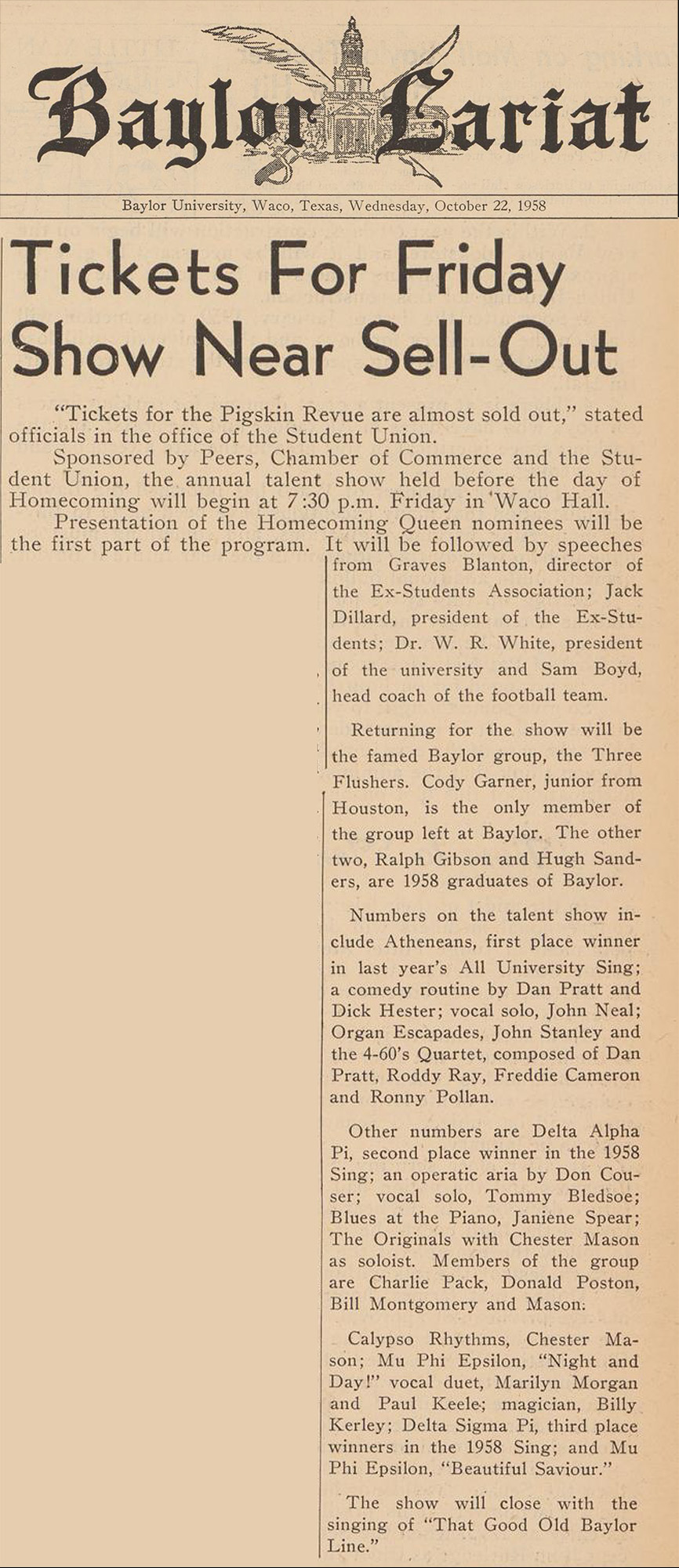
In 1955, Sing involvement exploded with 13 groups performing. A few years later in 1958, the creation of Homecoming's Pigskin Revue, showcasing the top acts from All-University Sing, increased the incentive for groups to participate.

Becoming What It Is Today
During the 1960s, Sing began to evolve into the production that we know today. In 1963, Sing "came off the risers" according to Mike Riemer, one of the previous Coordinators of Special Performances, when one of the groups decided to incorporate choreography and hand-held microphones into their act. Each group began to use more specific themes and all of the clubs started using choreography in their acts. Those that coordinated Sing began charging admission in 1964 after an overflow crowd of 3,000 had to be turned away at Sing's ten-year anniversary the previous year.

Building Rules and Framework
Throughout the 1970s and into the 1980s, Sing participation continued to rise. The competitions became so important in the eyes of each organization that group members began failing classes, albeit unintentionally, because of the amount of practice time and lack of studying. They also skipped classes in order to purchase tickets and the groups were spending thousands of dollars on their acts.
In response to faculty concerns, the Sing Procedures Committee was formed to enact stricter guidelines and regulations for each group. These limitations included forbidding pledge participation, setting a midnight curfew for practice time, and imposing budget limitations for the acts. While some rules have been adjusted over the years, many of these regulations are still in place today.

The Decade of Dynasties Among The Men
From 1993-1995, Phi Gamma Delta (Fiji), Phi Kappa Chi, and Kappa Omega Tau competed each year for the top three places. Fiji won the competition from 1993-1996 with Phi Chi placing behind them from 1993-1995. KOT made Pigskin each of those years, often placing third. During this time, a much darker and dramatic feel surrounded the acts. Fiji brought about this change in the style and theme development of the acts in 1993, with a shift to a reliance on heavy drama and almost completely eliminating choreography.

The Women Take Center Stage
The late 1990s and early 2000s have seen a heavier reliance on upbeat music, challenging choreography, and lighter, less dramatic themes. Beginning with Chi Omega placing first in Sing in 1999, women's groups again asserted themselves as a competitive force in All-University Sing. Recent years have seemed to indicate a balance in competition, with both male and female groups competing for the top spots each year.

The Modern Era
During the 2002-03 school year, the Baylor family celebrated the previous 50 years of Sing. The 50th Anniversary of Sing performances included a reunion for former sing chairs, an invitation to each former Coordinators of Special Performances, now Student Productions, to introduce the various Sing acts, and a museum displaying Sing memorabilia from the past 50 years. Sing 2012 marked the 60th Sing, a celebration that included a few surprises!
Throughout all of the changes in style, music, choreography, and policies, much of Sing has stayed the same. A dedication to quality entertainment, student involvement and group unity, and the enjoyment of working toward a common goal with a group of peers remain paramount.
"Sing is the essence and spirit of fraternity, youth, energy, talent, and a belief in a vision becoming tangible." - David Stephens (KOT 1977)